 Skip to content


At some point, most of us look around the home we have lived in for years and quietly wonder: will this still work for us ten years from now?
Very few people get to ask that question calmly. It usually arrives after a fall or a hospital stay, when senior-friendly home design suddenly becomes urgent, and every decision has to be made in a hurry.
That is why we love conversations that begin early. We have designed homes at some of Bangalore’s senior living communities, like Columbia Virtuoso and Ozone Urbana, and each family came to us with something different on their mind.
None of them arrived with a checklist. They arrived with treasured belongings, visiting children, and habits built over a lifetime. Here is what those homes taught us about senior living interior design in Bangalore.
Why Is It Better to Start Before You Need To?
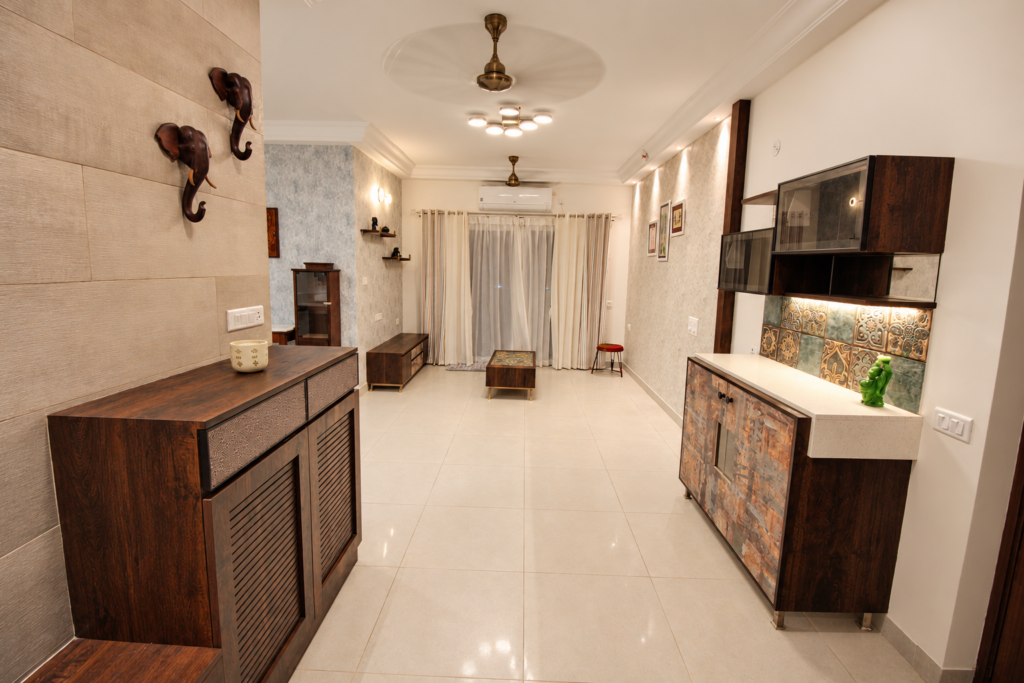
Shubha and Ravi came to us at around 60. They did not need a ramp or a grab bar. They simply wanted to do their home while they were still a little younger.
They bought two 2BHK apartments at Columbia Virtuoso and joined them into one large 4BHK. One side was planned for the two of them. The other side was for their children.
That side has its own kitchen. When the children visit, they can cook or have friends over without disrupting their parents’ routine.
Shubha and Ravi’s existing artwork and furniture were designed into the plan rather than replaced. The home was new, but nothing in it felt borrowed.
Starting early gave us time to ask the right questions. What do you want to keep? How do you spend an ordinary day? Who comes to stay, and for how long? That is where senior-friendly home design truly begins.
For most families we meet, the children living abroad or in another city is the defining fact. The home has to feel complete for two people on an ordinary Tuesday, and still welcome a full family for a few weeks a year.
A home planned at 60 can quietly adapt at 75. A home planned after a fall is often just a repair.
Want to know more about this project? Read the full story here.
Why Is Downsizing Harder Than Accessibility in Senior-Friendly Home Design?

When people hear “designing for seniors”, they usually grab bars and ramps. That matters, and we plan for them. But the hardest problem we met had nothing to do with safety.
Pooja and Col. Jayanth moved from a large 4BHK villa in Hyderabad to a 1BHK studio at Columbia Virtuoso. Jayanth is a retired Colonel, and the move was well considered.
Their friends and family are in Bangalore. Their children live abroad, and they travel often. After years of looking after a big house, they wanted a home that asked very little of them.
What was harder to prepare for was fitting a four-bedroom life into a 1 BHK. They were used to space and generous storage, and the question was how a compact home could still make room for what matters to them, something we have also written about in small space interior design.
Army life had also made them wonderful hosts. Their biggest worry was simple: when people come over, how will everyone fit? And they were bringing old furniture, including a bed they had no intention of letting go of.
So we began with questions rather than drawings. How many people usually come? How often? Do they stay, or visit for an evening? A studio can host a group beautifully, but only if that need is planned from the very first day.

This is the heart of small house design for elderly homeowners. Downsizing to a smaller home in India is rarely about owning less. It is about deciding what earns its place.
Their studio was planned around the things they would not let go of. Everything else was edited to fit around them. In a studio, senior-friendly home design is less about fitting everything in and more about choosing what stays.
To learn more about Col. Jayanth and Pooja’s home, read their story here.
Why Do Memories and Collectables Matter in Senior-Friendly Home Design?

Mr and Mrs Syali moved into Columbia Virtuoso with a lifetime of belongings. Their sofa set and their table came with them, and we made new beds to suit the new home.
Mrs Syali had also collected over 100 bells, along with a wider collection of artifacts. Her main worry was where they would all go.
We did not see these as things to be stored or boxed away. To Mr and Mrs Syali, they are not articles. They are the story of their lives. So they were part of the plan from the start, and each piece was given the place it deserved.
Mrs. Syali had also collected over 100 bells, along with a wider collection of artifacts. Her main worry was where they would all go.
In these homes, storage is not a square footage problem. It is an identity problem. A collection of bells says where someone has been and what they love. A sofa carries years of conversations.
When a person moves at 65 or 70, the things they bring are what make a new place feel like home. Good planning honours that first.
Why Does a Prayer Room Matter?

Mr. and Mrs. Syali also wanted a private prayer space, something close to the gurudwara setting they were used to, in a part of the home where visitors would not go. A space like this belongs in senior-friendly home design as much as any handrail does.
The apartment had a third bedroom that was dark and had no natural light. We made some civil modifications and turned it into their prayer room.
They were very particular about it, and we understood why. For many of the people we design for, the day has a rhythm built around prayer, and that rhythm needs a place. Their room began the way we think every one should, with how the family prays each day and what the space needs to hold, long before light, storage and finishes were decided. We have written a little more about that thinking in our note on pooja room design.
The Home That Made Room for a Life’s Story


What If You Are Moving in on Your Own?
Manjula’s home at Columbia Virtuoso was different again. She moved in on her own, and we kept the project lighter than we first planned.
She brought much of the furniture in the home with her. We did not try to replace it.
We planned the lighting, storage, and layout with the same care as in the other three homes, just with fewer things to place.
Not every home needs to feel full on its first day. Sometimes the kindest thing a designer can do is leave a little room, so that a person can settle in at her own pace. Senior-friendly home design can be as simple as that: a home that fits the person, not the other way around.


What Should You Decide Before Moving Into a Senior Living Community?
If you are planning a move like this, a few questions are worth answering early.
Which belongings carry real meaning, and which are simply there out of habit? Make this list first, even before you see a floor plan.
Who visits, and how long do they stay? This decides whether you need a guest room, a separate wing, or simply flexible seating.
What does your day revolve around? Prayer, reading, a morning walk, a hobby, a collection. Give each one a place.
What would you like to manage on your own ten years from now? That answer quietly shapes layouts, lighting and storage.
You do not need all the answers. A good designer will help you find them. But the more time you have, the better the home can be.
Why Are Senior Living Communities Growing in Bangalore?

More families are now looking for senior living interior design in Bangalore that understands what this kind of move involves. According to a Square Yards report covered by Outlook Money, India’s senior living market is projected to reach $11.43 billion by 2031, with Bangalore among the cities expected to keep drawing demand. Realty Today also reports that Serene Communities, the senior living platform of Columbia Pacific Communities, plans to invest ₹3,000 crore across six cities, Bangalore included.
Communities such as Columbia Virtuoso, also listed as Columbia Pacific Virtuoso, and Ozone Urbana are coming up in good locations, and we have been fortunate to design homes in them.
Across all these homes, one thing stayed the same. Senior-friendly home design is less about the home and more about the person moving into it: what they own, who visits them, and how they like to begin and end a day.
At Inner Space, we believe the best time to plan a home for the next chapter is before you need to. If you are thinking about it, we would be happy to talk.
Frequently Asked Questions
